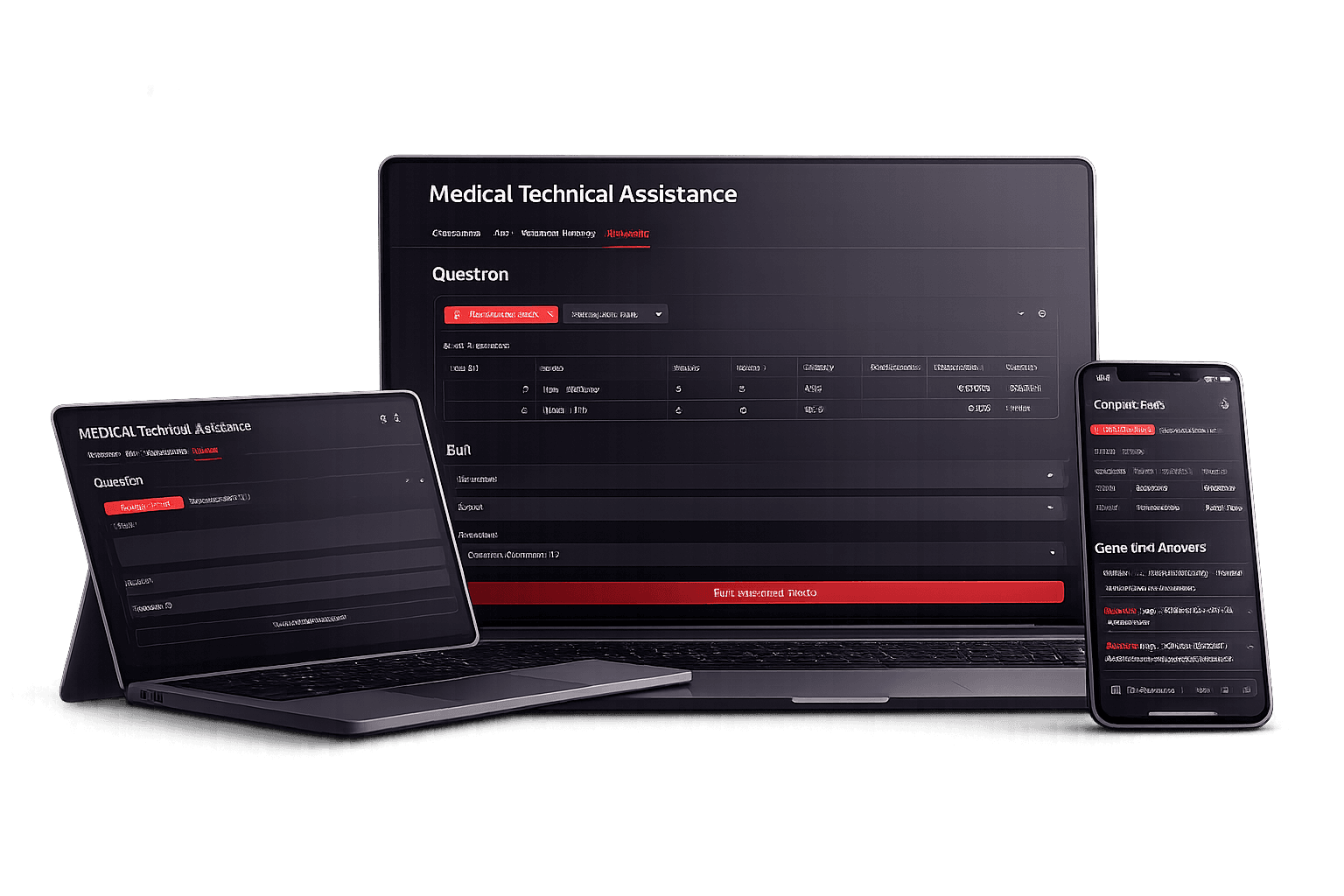
An AI-powered medical support platform that combines Retrieval-Augmented Generation (RAG), validated memory, local LLMs and evaluation tooling to help healthcare professionals troubleshoot medical equipment faster and more accurately.
Project overview
The Problem
Healthcare technicians often spend significant time searching through lengthy medical equipment manuals.
Traditional documentation is difficult to search.
General-purpose LLMs may hallucinate when answering technical questions.
Organizations need a reliable way to reuse previously validated troubleshooting knowledge.
The Solution
Built an AI-powered troubleshooting assistant that combines Retrieval-Augmented Generation, local LLM inference, validated memory and structured evaluation tooling.
Retrieval-Augmented Generation (RAG)
Local LLM inference through LM Studio
Validated memory for previously confirmed answers
Semantic document search
Automated evaluation comparing Plain LLM, RAG and RAG+Memory
Project Overview
Industry
Healthcare AI
Platform
AI Web Application
Role
AI Engineer / Full Stack Developer
Duration
3 Weeks
Status
Production Ready
Screenshots
A glimpse of the platform
Click any screenshot to view it in full resolution.
Documents Upload
Upload PDF manuals and process them into searchable knowledge.
Ask Assistant
Ask technical questions with configurable retrieval settings.
Validated Memory
Store expert-approved answers for future reuse.
Evaluation Runner
Configure evaluation runs comparing Plain LLM, RAG and RAG Memory.
Evaluation Results
Review generated answers, latency and evaluation metrics.
Run Comparison
Compare different AI strategies side by side.
Key Features
Everything in one platform
PDF Upload
Upload technical manuals and process them into structured searchable knowledge.
Automatic Document Chunking
Long manuals are transformed into retrieval-friendly chunks for grounded answers.
Semantic Search
Questions are matched against the most relevant technical content using embeddings.
Retrieval-Augmented Generation
Answers are generated using retrieved evidence instead of relying on raw model memory.
Validated Memory Reuse
Previously confirmed technical solutions can be stored and reused across future queries.
Local LLM Support
The platform supports local inference through LM Studio for private deployment setups.
GPT Fallback
Alternative answering flows can be compared when local and remote strategies differ.
Evaluation Framework
Structured evaluation compares Plain LLM, RAG and memory-enhanced pipelines.
Run Comparison Dashboard
Experiments can be inspected side by side for latency, quality and grounding behavior.
Confidence Scoring
Generated answers can be reviewed with confidence-oriented signals and traceability.
Manual Evaluation Workflow
Groundedness, hallucination and relevance can be assessed through human review.
Research Metrics
The platform supports experiment tracking and benchmark-driven iteration.
Challenges
Designing a reliable retrieval pipeline
The system needed to minimize hallucinations while still retrieving enough context for accurate technical guidance.
Building a validated memory system
Previously confirmed troubleshooting solutions had to remain reusable without polluting future answers.
Balancing confidence thresholds
Retrieval confidence needed careful tuning to preserve both response quality and groundedness.
Supporting local LLM inference
The platform had to work with local models through LM Studio instead of relying only on cloud providers.
Results
Reduced hallucinations
Grounded document retrieval improves reliability for medical technical troubleshooting.
Reusable validated knowledge
Previously confirmed answers can be stored and reused to improve future assistance.
Fast semantic search
Technical manuals become easier to query and navigate through semantic retrieval.
Complete evaluation framework
The platform supports dissertation-style comparisons across multiple AI answer strategies.
Scalable architecture
The system is ready to extend toward larger medical datasets and future experiments.
Ready to build AI-powered assistants?
Let's build intelligent applications using RAG, LLMs and modern AI architectures.